There are things I wish every doctor understood about living with a rare disease—not because they lack skill, dedication, or compassion, but because the lived experience of chronic and rare illness is something no medical training can fully capture.
When I walk into an exam room, I’m not just bringing symptoms, lab values, or imaging results. I’m carrying years of uncertainty. I’m carrying fear that learned to live quietly alongside hope. I’m carrying resilience that was never optional—and the determination it takes to keep showing up, appointment after appointment, when answers remain elusive.
This letter is not a criticism. It’s an invitation.
An invitation into the emotional landscape rare disease patients navigate every single day.
A reminder that behind every chart is a human being longing to be seen, heard, and understood.
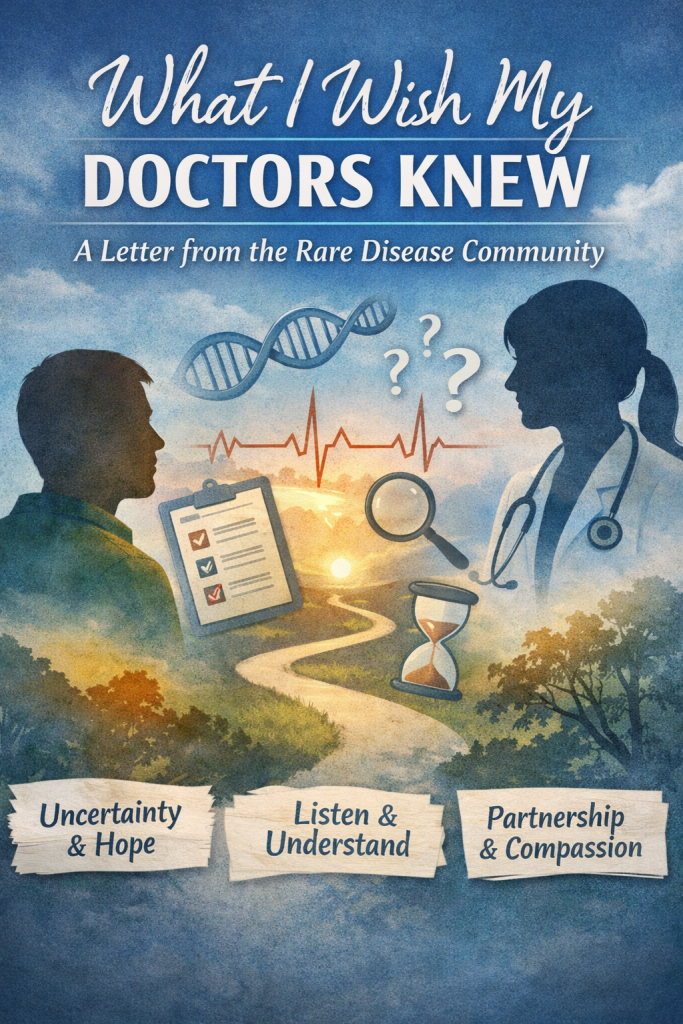
The Emotional Landscape of Rare Disease
For many of us, the road to a rare disease diagnosis is long and winding. It often spans months—or years—marked by vague symptoms, inconclusive tests, and explanations that never quite fit. We move from specialist to specialist, collecting referrals, procedures, and unanswered questions along the way.
Living in this diagnostic gray zone takes a profound toll.
It’s exhausting to be the “mystery case.”
To be told, “Your labs look fine,” when your body says otherwise.
To feel like an outlier—someone who doesn’t respond the way textbooks predict.
And yet, we keep showing up.
We keep advocating.
We keep tracking symptoms, researching possibilities, and hoping the next appointment might bring clarity. What we carry into the exam room is often invisible—but it is heavy. And when a physician acknowledges that weight, even briefly, it changes everything. It transforms an appointment into a partnership.
What I Wish You Knew
“I’m not just a case—I’m a person.”
When you look at me, I hope you see more than a diagnosis code or an imaging report. I hope you see the human being sitting across from you—someone with a family, a history, a life that existed long before illness entered the picture.
A moment of eye contact.
A pause to listen.
A simple, genuine question like, “How are you holding up?”
These small gestures build trust faster than any test result ever could.
“Uncertainty is my daily companion.”
Rare disease often means living without clear answers. Diagnoses evolve. Symptoms overlap. Treatments are frequently trial-and-error. Plans change.
When you say, “I don’t know—but I’m committed to figuring this out with you,” it gives us something solid to stand on.
We don’t expect you to have all the answers.
We just need to know we’re not navigating the unknown alone.
“I’ve done my homework—please honor that.”
Many of us arrive informed—not because we doubt your expertise, but because this disease affects every corner of our lives. We research because we have to. Because survival, quality of life, and hope depend on it.
When we bring articles, questions, or observations, we’re not challenging you—we’re trying to participate in our own care.
Collaboration empowers us.
Dismissal discourages us—and sometimes silences us.
“Hope matters more than you realize.”
Your words carry extraordinary weight. A single sentence can lift us—or flatten us.
We value honesty. We understand limitations. But compassion matters just as much as accuracy. When you balance truth with encouragement—when you remind us that there is still life to be lived, still meaning, still joy—you help us endure the hardest days.
Hope doesn’t mean false reassurance.
It means helping us believe our lives still matter.
A Call to Action
To every healthcare provider who cares for rare disease patients:
We don’t need perfection.
We don’t need certainty.
We don’t need you to fix what cannot be fixed.
What we need is partnership.
We need you to listen with curiosity.
To speak with empathy.
To treat us as collaborators in our own care.
We need you to acknowledge the emotional weight we carry—even when the medical path forward is unclear. Small shifts matter more than you may realize: validating concerns, explaining your reasoning, offering resources, or simply saying, “I hear you.”
These moments don’t take extra time—but they leave a lasting impact.
Closing Thoughts
If you’re a healthcare provider reading this, please know how deeply your presence matters. Your words, your curiosity, your willingness to listen—these shape our courage more than you may ever realize.
Rare disease patients don’t expect instant answers. What we hope for is connection. We hope for empathy. We hope for a seat at the table in our own care.
Thank you for the work you do.
Thank you for the lives you touch.
And thank you for the moments when you choose compassion over hurry.
From one human being to another—we see you.
And we’re grateful to walk this road together.


Leave a Reply